
Pico vs. Nano Laser Tattoo Removal Faceoff
How many sessions will it take for tattoo removal?
That is, hands down, the most common question I hear when someone walks in ready to part ways with old ink.
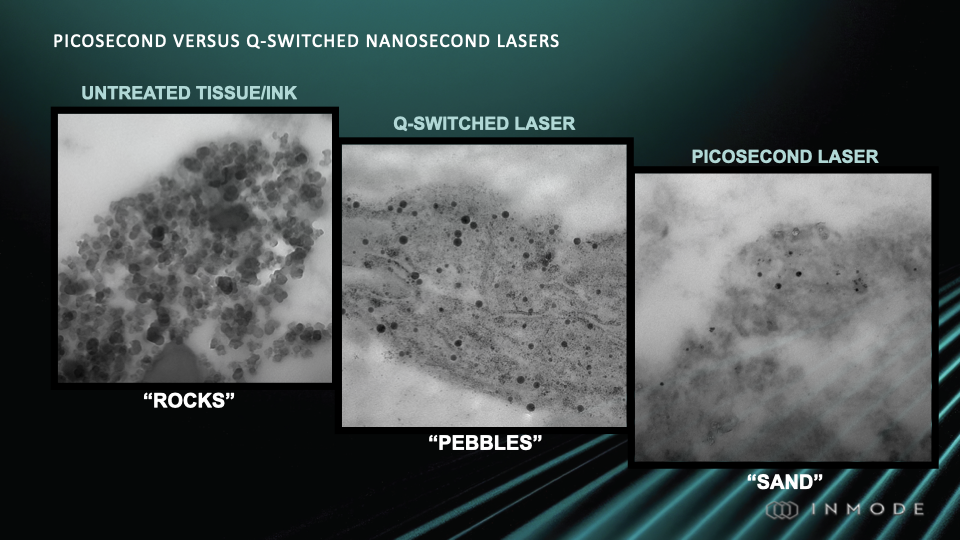
The honest answer depends on your tattoo, your skin, and the technology doing the work. At Eocene, we use Picofy, a next generation picosecond laser for tattoo removal. We tell patients, compared to older technologies such as Q-switch or nanosecond lasers, pico is superior because it works faster, takes fewer sessions, and is less painful.
But how do we know? A well-designed clinical trial published this year finally gives us clearer numbers to talk about. This blog post kicks off our “What’s the evidence?” column where we’ll dissect journal articles and scientific publications to get to the bottom of clinical evidence behind aesthetic medicine treatments.
Pico vs. Nano Split Tattoo Study
A 2026 randomized trial published in Plastic & Reconstructive Surgery compared the effectiveness of tattoo removal with a picosecond laser against a nanosecond laser. The same tattoos in the same patients were split in half and received treatments from either the pico or nano laser. The two lasers used the exactly same wavelength (755 nm Alexandrite). Thirty patients with black or blue ink (professional, amateur, and cosmetic) received five treatment sessions spaced three months apart, then were followed for six additional months.
The picosecond-treated sides scored significantly higher for clearance. Evaluators who didn’t know which side of the tattoo were treated by which machine rated the clearance level on a scale of 0-10. The side of the tattoo treated with the pico laser had a median score of 8 out of 10 versus 5 for the side treated with the nano laser. Satisfactory clearance, defined as a score of 7 or above, occurred in 73% of tattoos for pico, compared to 23% for nano. This means pico is almost as three times as effective as nano in tattoo removal. The results are overall consistent with previous studies (such as this one from 2017) that showed pico is more effective than nano.
Pain scores were also lower with pico treatment. And the occurrence of side effects like blistering and crusting were roughly halved.
In plain language: pico delivered more fading, with less discomfort and fewer short-term side effects, across a realistic treatment series.
Is Clearance Possible?
In this study, complete disappearance happened in about 10% of pico-treated sites and none of the nanosecond sites. Remember this is after 5 sessions spaced 3 months apart. Laser tattoo removal is a fading process — your immune system does the heavy lifting after the laser shatters ink particles small enough for macrophages to carry away.
In clinical practice, I usually tell patients that for a previously untreated tattoo, you will see substantial fading after a series of 5 to 6 sessions with Picofy. We need to allow at least 6 weeks in between the sessions to allow your body to clear the shattered ink. Complete or near complete clearance may be achieved after 8 sessions. But we cannot expect every trace of ink to vanish overnight.
Factors that influence how far you get include ink density and layering (professional tattoos typically sit deeper than amateur ones), ink color (black and dark blue absorb broadly; greens, yellows, and certain reds are harder targets), skin type and healing response, and location on the body (areas with strong blood supply tend to clear faster).
What About Side Effects?
Tattoo removal with the older, nanosecond, or Q-switch technology has been associated with pain, blistering, itching and swelling. All of these aspects seem to have improved with pico, again affirming what we’d known from previous studies.
However, the trial found one trade-off worth mentioning: transient hyperpigmentation — temporary darkening of the treated skin — was more frequent on the pico side (21% of patients vs. 12% for nano). It typically resolved over days to weeks. This underscores why sun avoidance before and after treatment matters, especially in summer.
We assess skin type and sun exposure history carefully at every consult because these details shape the treatment plan.
How We Approach Tattoo Consultations
At Eocene, we map the treatment plan around your tattoo, not a generic brochure. We evaluate ink colors, density, age of the tattoo, location, Fitzpatrick skin type, and your expectations. Picofy breaks down the tattoo ink into microscopic particles, much smaller and easier for your body to clear. Sessions are typically spaced 6-8 weeks apart to let healing take place between treatments.
Not every tattoo is a good candidate for complete removal, and we will tell you that up front. Many patients want substantial fading or toning, or localized editing, sometimes to prep for a new tattoo, and that is a perfectly reasonable goal.
Ready for tattoo removal in Springfield, Illinois?
If you have been thinking about fading, editing, or removing a tattoo, we at Eocene Medical Spa invite you to a complimentary consultation. We will assess your ink, your skin, and your goals, then outline a realistic timeline — no pressure, no oversold promises. Candidacy, risks, and aftercare are all reviewed in person.