
What Does Laser Tattoo Removal Actually Feel Like?
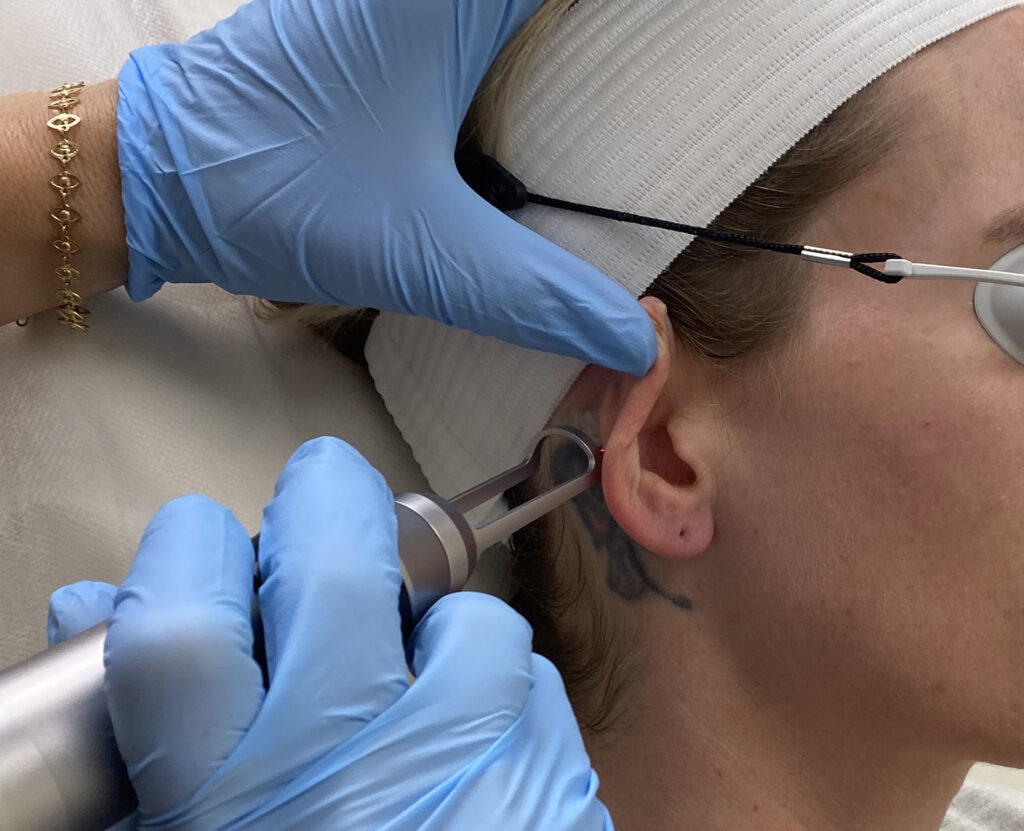
“Does it hurt?” is not the first question almost every tattoo removal patient asks, but it’s being asked frequently enough. Honestly, it deserves a straight answer.
What laser tattoo removal actually feels like
The most common description we hear: a rubber band snapping against the skin, fast and sharp. The American Society for Laser Medicine and Surgery compares it to “hot specks of bacon grease.” Neither analogy is perfect, but they capture the quality — brief, intense pulses of heat and pressure, not a slow burn.
One of our patients combined the analogies “rubbing band with hot spikes snapping”. (Granted, the tattoo was on the inside of her wrist, a very sensitive area with thin skin and three major nerves right under the skin.)
Most patients rate the sensation somewhere between 3 and 6 on a scale of 0 to 10 (0 being no pain at all, 10 being the worst pain possible – putting on my anesthesiologist hat here). If you sat through getting the tattoo, you have a useful reference point. Removal tends to feel sharper but shorter. A session on a small tattoo often takes just a few minutes — sometimes less than sixty seconds of actual laser time.
How we keep tattoo removal pain manageable
Nobody has to white-knuckle through a tattoo removal session. We apply a topical numbing cream about an hour before treatment. If you don’t want to sit here and wait the hour, we can prescribe the numbing cream for you to apply at home before you come in. We can also prescribe you Journavx, a new, non-opioid, non-addictive pain pill to take on the day of the procedure.
For more sensitive areas, a local anesthetic injection under the skin can make the procedure essentially painless during the pulses themselves. Cooling with cold packs and vibration distraction devices reduce discomfort in real time. We apply a soothing cream right after the treatment and send you home with ice packs, too.
We’ll walk you through all comfort options before you ever hear the first pulse.
The frosting reaction (it looks dramatic, and it’s normal)
Right after the laser passes over the ink, the treated skin turns white and slightly puffy. It’s what we call the “frosting” reaction. It can look alarming if you’re not expecting it. This is a normal sign that the laser energy has reached the ink particles and created tiny gas bubbles in the skin. The frosting typically fades within twenty to thirty minutes, leaving redness and mild swelling behind.
What recovery actually looks like after tattoo removal
The hours and days after a session follow a predictable pattern:
- Day of treatment: The area feels like a concentrated sunburn — warm, tender, slightly swollen. Soothing ointment and a light bandage go on before you leave.
- Days 1–3: Redness and swelling are common. You may have a few blisters, which is a normal part of the healing process. Do not pop or pick at them. Using the advanced picosecond technology has greatly reduced the risk of blisters compared older Q-switch lasers.
- Days 4–7: Swelling resolves; light scabbing or flaking may appear. Keep the area clean, moisturized, and out of direct sunlight. You may feel itchy as the tissue starts to mobilize the pigments and carry them away.
- Weeks 2–6: Your body’s immune cells are doing the invisible work — clearing fragmented ink particles from the treatment site. The tattoo gradually fades between sessions.
Sessions are spaced six to eight weeks apart to give skin time to heal and your body time to clear ink. Most tattoos require 6-8 sessions for maximum fading, depending on ink colors, depth, tattoo age, and your body’s own immune response.
What makes the experience easier or harder
A few factors shift the comfort dial:
- Location matters. Bony areas and spots with thinner skin (ankles, ribs, wrists) tend to be more sensitive than well-padded areas like the upper arm or thigh.
- Ink density and color. Dense, dark ink absorbs more laser energy per pulse. Black and dark blue respond best; greens and lighter colors can require more sessions with specialized wavelengths.
- Session number. Many patients report that middle sessions feel more manageable — there’s less ink to absorb the energy, and anxiety drops once you know what to expect.
- History of treatment. Scar tissues may have formed over the tattoo if the initial tattooing process was traumatic, or if you had removal attempts with older lasers. Ink embedded in scars require stronger pulses which can be more painful.
Ready to learn more about laser tattoo removal in Springfield?
If you have a tattoo you’ve been thinking about fading or removing, the best first step is an honest conversation — not a commitment. At Eocene Medical Spa in Springfield, Illinois, we’ll evaluate your tattoo, walk you through a realistic treatment plan, and answer every question before a single pulse is fired. Book a complimentary consultation and find out what’s possible for your skin.
p.s. So what is the first question every tattoo removal patient asks, you say? Well, thank you for reading til the end! It’s… “Can you get rid of this?”