
Ozempic Face: What GLP-1 Weight Loss Can Do to Your Skin and What Actually Helps
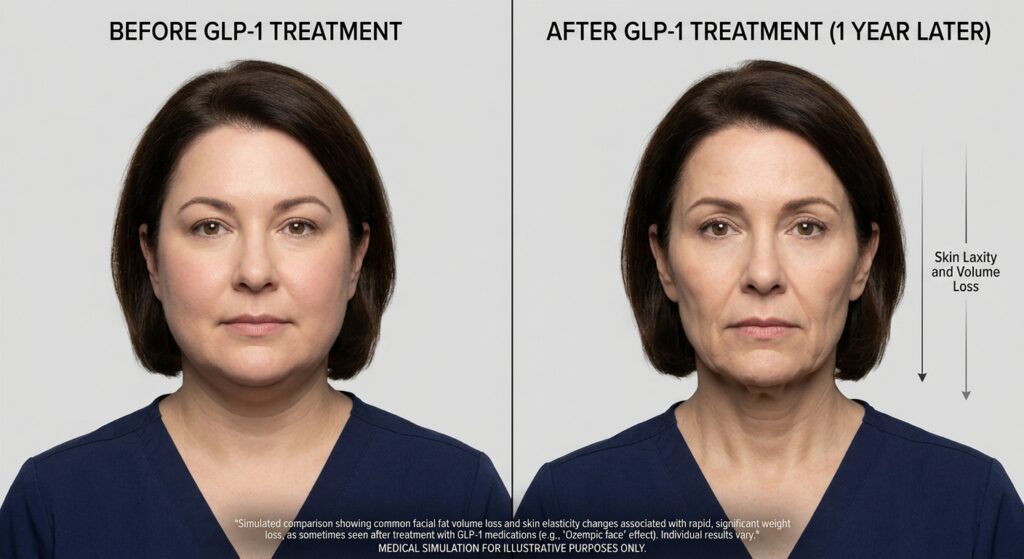
You worked hard to control your diet and cravings, you stuck with your medication plan, and the scale finally reflects it. But then you look at yourself in the mirror and something feels… off. Your cheeks seem flatter. Your temples look hollow. Your neck droops like a bag. Lines you never noticed before are suddenly there.
You are not imagining it. And you are not alone.
What is “Ozempic face”?
“Ozempic face” is an informal term for the facial hollowing, skin laxity, and volume loss that can follow rapid weight loss. It’s become more common with the widespread use of GLP-1 medications like semaglutide (brand name Ozempic or Wegovy) or tirzepatide (brand name Moujaro or Zepbound). Cleveland Clinic endocrinologist Dr. Vinni Makin describes it as “gauntness, sunken cheeks, new wrinkles, and loose skin on the face and neck.”
To be clear: this is not a side effect of the medication itself. It is what happens when you lose facial fat faster than your skin and soft tissue can adapt. Anyone who loses a significant amount of weight quickly — with or without medication — can see these changes. GLP-1s make substantial weight loss more achievable for more people, which means more patients are noticing the facial trade-off.
Why the face shows it first
Your face carries distinct fat compartments — in the cheeks, temples, around the eyes, along the jawline. These pads give your face its shape and fullness. When weight drops rapidly, these compartments deflate, and the skin that once draped over them has less support underneath.
The result: hollow cheeks, deeper nasolabial folds, a more visible skeletal contour, and skin that looks looser than it did at the same weight years ago. Patients over 40 tend to notice it more, because baseline collagen and elasticity are already declining.
A 2026 critical review of 44 studies confirmed that these changes represent a recognizable soft-tissue pattern — not a medical condition unique to any one drug.
What you can do about it
The good news: this is manageable, and you do not have to choose between your weight-loss goals and your face.
Prevention during weight loss:
- Pace matters. Gradual weight loss — roughly one to two pounds per week — gives facial skin more time to adjust. Work with your prescribing physician on a timeline that balances metabolic with aesthetic goals.
- Protein and resistance training. Adequate protein intake and strength exercise help preserve muscle mass and support skin structure during weight loss.
- Sun protection. UV damage accelerates collagen breakdown. Daily broad-spectrum SPF is non-negotiable.
I have to insert a public service announcement here: please, don’t inject yourselves with GLP-1s without physician guidance. The drugs are widely accessible now on the gray market and too many patients are liberally dosing themselves without a handle on how their body changes. Individualized dosing with incremental adjustment, close monitoring for side effects, and comprehensive plan with exercise and nutrition is the best way to prevent Ozempic face and saggy skin all over the body.
Treatment after changes appear:
A 2026 expert panel in the Aesthetic Surgery Journal Open Forum recommends a multimodal approach — not just one treatment, but layered strategies tailored to what your face actually needs:
- Hyaluronic acid fillers to restore volume where fat pads have deflated — cheeks, temples, under-eyes, jawline.
- Collagen-stimulating injectables like poly-L-lactic acid (Sculptra) to rebuild tissue quality gradually from the inside out.
- Energy-based devices — RF microneedling, monopolar and bipolar RF, ultrasound, or fractional lasers — to tighten lax skin and improve texture.
- Neuromodulators to soften dynamic lines that have become more prominent.
The key word is individualized. A cookie-cutter approach does not work here, because every patient’s weight-loss journey, facial anatomy, and skin quality are different. Timing matters, too — your treatment plan may evolve as your weight stabilizes.
Ready to talk about your skin after weight loss in Springfield?
If you are on a GLP-1 medication — or have recently completed a weight-loss journey — and you are noticing changes in your face, we get it. We have helped other patients through their journey.
A complimentary consultation at Eocene Medical Spa lets us assess your unique anatomy, discuss realistic options, and build a plan that supports both your health goals and how you feel when you look in the mirror. No pressure, no cookie-cutter protocols — just an honest conversation about what is possible for you.