
Can Picosecond Lasers Help Fade Acne Scars
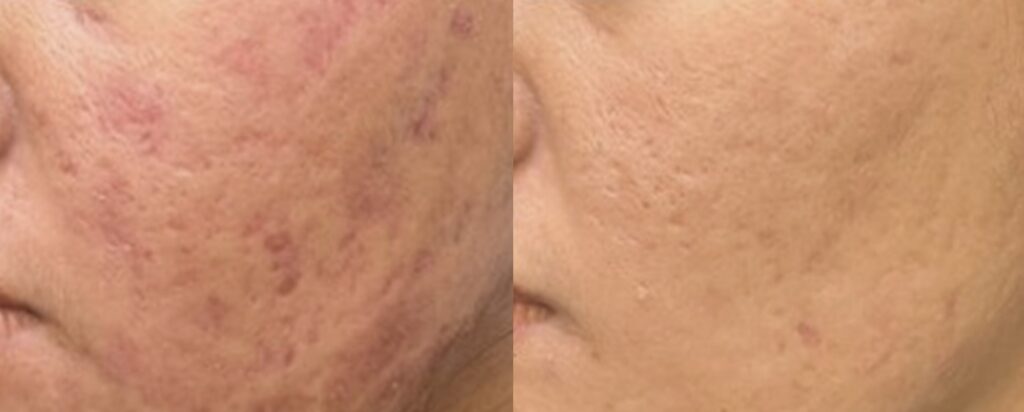
We’ve talked about acne scars and RF microneedling. Another effective treatment option is picosecond lasers. But if you search about acne scars and laser on the Internet, you’ll get a mix of hope and skepticism. Patients who say “lasers changed my skin” and those who say “lasers didn’t do anything.” The honest answer is more nuanced: a picosecond laser can meaningfully improve acne scar, with the right settings and treatment sequence. But it isn’t an eraser, and the changes doesn’t happen overnight.
What picosecond laser actually does
Picosecond lasers – like Picofy by Inmode which we have here at Eocene – fire energy in trillionths-of-a-second pulses. The laser beam shatters the target scarred tissue into fragments the body then clears naturally. Because the laser beam is so far, it deposits less heat into the surrounding normal skin than older, slower lasers.
For scarring, that gentler heat profile stimulates the skin to lay down new collagen and elastin as it heals. These proteins rebuild the extracellular matrix and gradually smooth out the skin texture.
Unlike a surgical excision (cutting out the scar), the picosecond laser does not directly “remove” the scar tissue. It makes the scar less noticeable by promoting the body to rebuilt better skin.
Which scars respond the best
Picosecond lasers are built for atrophic scarring. These are the shallow, rolling, and some boxcar-type indentations or dimpling left behind after inflamed acne heals.
In a randomized split-face trial, patients treated with a picosecond laser saw a 55% reduction in scar-severity scoring after four sessions, compared to 42% on the side treated with a non-ablative fractional laser — with less pain and fewer side effects on the picosecond side. Another split-face study comparing picosecond to a fractional thulium laser found both improved scarring significantly, with the picosecond side showing less downtime and a slightly higher physician-rated improvement score.
What about the other types of scars
Scars with red or brown discoloration also respond to picosecond laser treatments. Here the laser targets the pigmentation, in particular post-inflammatory hyperpigmentation (PIH). Traditional thermal lasers can aggravate PIH. The gentler picosecond laser, administered with a fractional toning technique, can lighten PIH and smooth out the scar texture.
Raised or hypertrophic scars require a combination approach – corticosteroid injections to less the inflammation, picosecond laser to improve collagen production, and resurfacing laser (Erbium or CO2) to physically shave down the texture. Adding platelet-rich plasma or exosomes rich in growth factors can further boost the skin’s healing capacity.
Individualized approach to your scar
The takeaway for scar treatment isn’t “pick the winner.” It’s that several approaches work, picosecond among the strongest, and combining tools often outperforms any single laser used alone.
Every scar is different. What caused it? Acne, surgery, trauma, or bug bites (I personally have a scar prone skin type and develop PIH with mosquito bites)… Where on the body is it? Is it raised or sunken? Any discoloration? These are the questions we’ll ask to assess your scar and come up with a individualized plan that may include picosecond lasers, as well as other treatment modalities.
What to expect with picosecond laser treatment for acne scars
You’ll see incremental improvement in texture and color of the scars, but it will take multiple sessions, not one. Most clinical trials treated patients for 3-4 monthly sessions. Sun protection before and after each session isn’t optional; showing up tanned or sunburned means we can’t safely treat that day. Skin tone also changes the settings: deeper Fitzpatrick types need a more conservative approach and limit which wavelength we can safety apply.
Ready to talk about your scars in Central Illinois?
If you’ve been living with acne scarring and want an honest read on whether picosecond laser fits your scar type and skin, that’s exactly what a complimentary consultation is for — we’ll look at what you actually have before recommending anything.