
At-Home Picosecond Laser Pens vs. In-Office Picofy: What the Power Difference Means for Your Safety
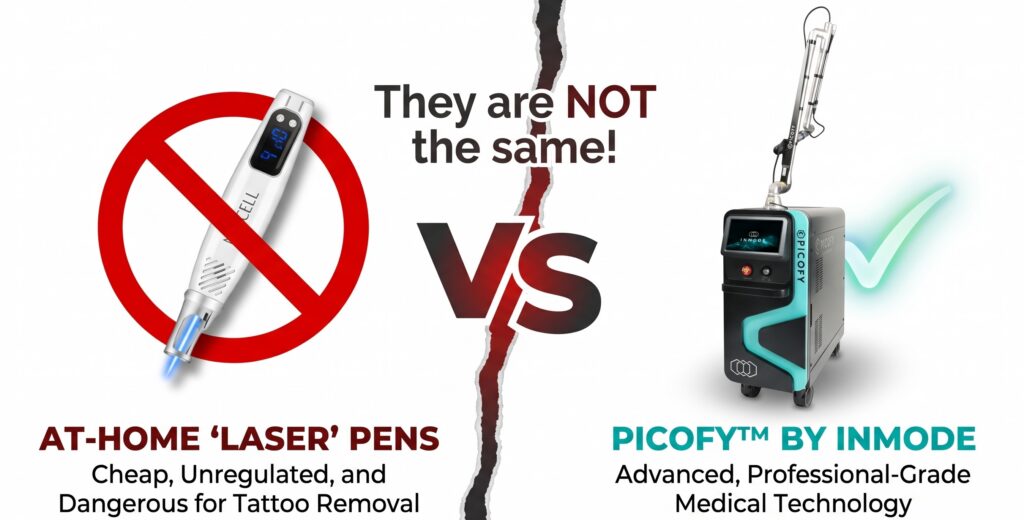
Searches for “picosecond laser pen” have climbed sharply this month. I wasn’t sure what it was, and after looking into it, I had to write this article. As a physician and patient advocate who wrote about health literacy for our local newspaper for years, patient safety matters a lot to me. I can’t watch you potentially harm yourself with unregulated and ineffective devices.
What are picosecond laser pens?
You see them for sale on Amazon, AliExpress, eBay, and manufacture direct websites. There’re several brands being talked about on social media – I won’t name them but basically they’re all white-labeled devices manufactured in Chinese factories. They’re hand-held pen-like devices powered by a battery or USB-charger. It emits red or blue light and claims to remove unwanted tattoos.
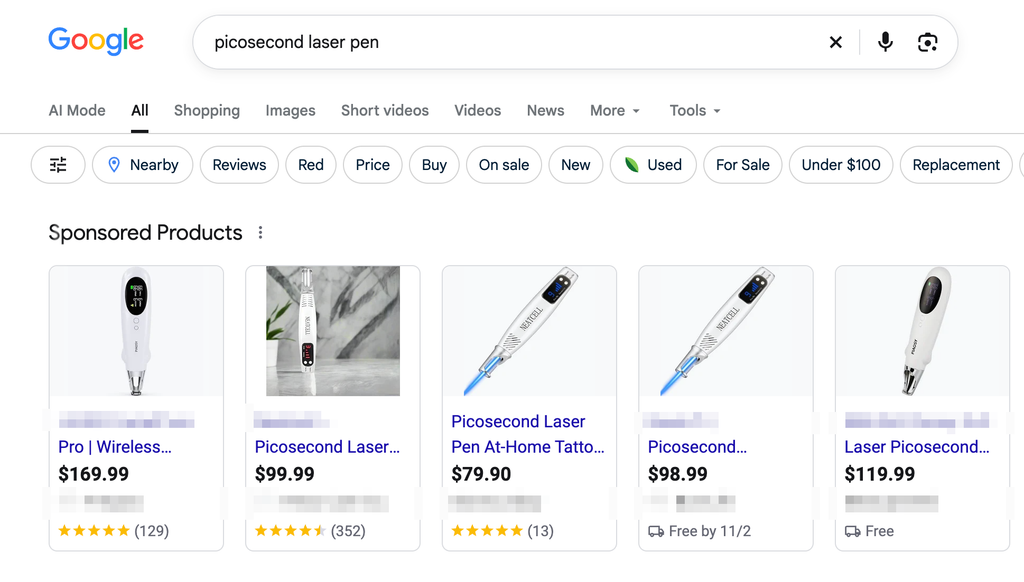
If you look for the technical specs of these devices, it’s not surprising that you find very little information. Are the light emitted actually lasers (focused, in a single wavelength, with the light rays aligned)? What is the medium through which they generate the light energy? How long exactly is each pulse (“pulse duration”), is it actually counted in picoseconds, how many picoseconds? What is the power output (“fluence”) of each pulse? There’s nothing in the product descriptions or instruction manuals that talks about these key parameters used to describe medical lasers.
Why? Because these devices are not medical lasers and they don’t work like one.
What “picosecond laser” actually means
Picofy by Inmode, the picosecond laser we use for tattoo removal at Eocene can hit a peak power of about 2 gigawatts in a pulse that lasts 300 picoseconds (300 trillionths of a second). Picofy plugs into a 220V outlet via a specialized locking connection. Our electrical usage flies up whenever the laser is on. The laser energy is pumped through a solid-state Nd:YAG crystal, and regulated by computer-controlled mirror system to deliver precise and consistent fluence.
Maybe these numbers are too abstract. Let me explain why it matters in the clinical setting.
For tattoo removal, you want to destroy the ink pigment without damaging the surrounding skin. Older tattoo-removal lasers work in the nanosecond range (billionths of a second). That’s fast enough to heat and fracture pigment particles, but some of that heat still spreads into the surrounding skin.
Picosecond lasers compress the same (or more) energy into a pulse about a thousand times shorter. At that timescale, the laser outruns what’s called the stress relaxation time of the pigment particle. The pigment doesn’t just heat up, it shatters (“photomechanical shockwave”) before the heat has anywhere to go. The practical result is pigment that fragments into pieces small enough for your body’s immune cells to clear, with less collateral heat damage to healthy skin tissue.
How a true picosecond laser is engineered
Here’s the part that matters for safety. Getting that photomechanical effect requires both an extremely short pulse and very high peak power delivered through a precisely controlled beam. Picofy is built around that exact combination: a 300-ps pulse at up to 2.0 GW of peak power, dual wavelengths for different pigment colors and depths, and thermal lens control and power factor correction to keep that energy consistent and contained to the treatment site.
Picofy is a Class 4 (highest level) medical laser and cleared by FDA as Class II medical device, built with a key switch, interlock, and emergency stop, and meant to be operated by a trained clinician — not a consumer.
Do you think a pen in a plastic-casing powered by 5V USB cable can achieve the same?
“Picosecond laser pen” is not really picosecond or laser
Even if a product markets itself with the word “picosecond,” matching the name doesn’t mean matching the physics. None of the “picosecond laser pens” on the market has official FDA clearance as a medical laser. Actually FDA would never clear a medical laser for over-the-counter (over-the-Internet) at-home use by a consumer.
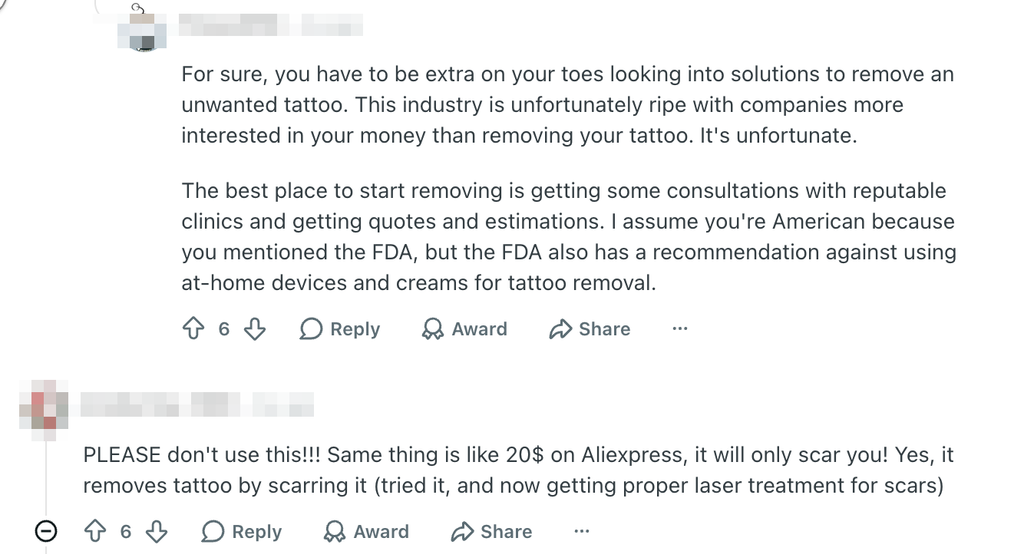
So the only explanation that makes sense is that these are not picosecond lasers. Without that power and precision, a device either doesn’t do much to the pigment, or it concentrates whatever energy it has into the skin’s surface instead of the target pigment. That’s where burns and scars come from, not fading tattoos. Indeed, posts on social platforms like Reddit recounts consumers burning and scarring themselves with those pens.
Should you use a “picosecond laser pen” to remove your tattoos at home?
The FDA has cleared picosecond and other tattoo-removal medical lasers for use by a trained health care professional — full stop. It has not approved any do-it-yourself laser pen for tattoo or pigment removal at home.
That’s not a technicality: the agency has an actual adverse-event report on file describing a lay user who was burned by a picosecond laser pen from a popular brand. The complaint alleges that the seller falsely advertised FDA approval for home use. Watch out for fraudulent “FDA approved for home use” claims on the listings. Real FDA clearance always ties to a specific, verifiable device, not a marketing line on a product page.
If you’re dealing with a stubborn tattoo, sun-driven pigment, or acne scarring, the honest path is a consult with a licensed, experienced medical provider, not a home device. We’ll look at your skin, check the pigment characteristics, and match wavelength, pulse settings, and session protocols to make the most effective and safe for you.
The bottom line
It’s sickening that online sellers would use “picosecond” as a hot marketing word without delivering what the term means in physics and engineering. What actually tells you whether a device can safely fracture pigment is pulse duration and peak power, and that number is where consumer pens and clinical platforms part ways by orders of magnitude. If you’re curious about a pen you saw online, bring it up at your consult — we’d rather talk you through why it won’t do what the listing promises than have you find out the hard way.
Ready to treat pigment or tattoos the right way in Springfield, Illinois?
If you’ve got a tattoo, stubborn pigments, or sun spots you’re ready to be done with, a complimentary consultation at Eocene is the place to start. We’ll check that any spot is safe to treat, match the right picosecond settings to your skin, and give you a realistic session count — no guesswork, and no plastic USB-powered pen required.